
TRAINING SESSION
Scoring goals with antagonistic runs: an intermediate level training session

The analysis of Bernardo Silva’s first goal for Manchester City against Real Madrid in the 2022/2023 Champions League semi-finals highlights two main tactical principles:
- Antagonistic third-man runs: runs that go against the direction of a previous pass, splitting the opponent’s attention to create free spaces.
- Attacking spaces on distraction: players exploit these spaces to progress, an at the end, attack the spaces generated in the backline of the first defensive unit to receive a pass or misplace the defenders even more.
This training session will make these principles operational for intermediate-level players. While it can also be used with elite players, we will soon provide a specific session with the same principles designed for advanced and elite levels.
Keys to read the figures:

1. WARM UP: PASSING PRACTICE WITH ANTAGONISTIC THIRD MEN RUN
Exercise is presented in two panels, showing the same core concept with different movements. The aim is to comprehend the player’s antagonistic run in relation to the ball movement.
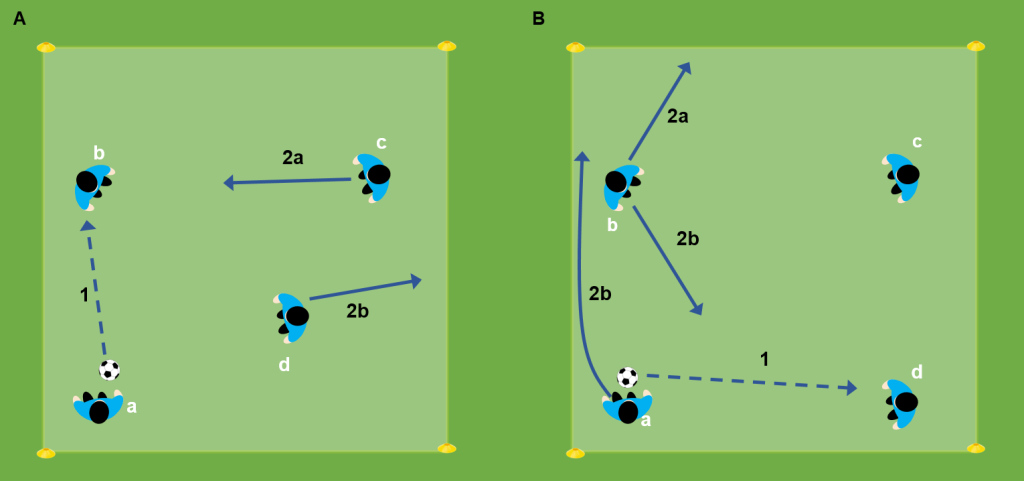
Panel A: When a vertical pass is made from player ‘a’ to ‘b’ [1], player ‘c’ makes a horizontal run [2a]. A coordinated run [2b] is also possible, with player ‘c’ moving inward and player ‘d’ moving outward at the same time.
Panel B: When a horizontal pass is made (from player ‘a’ to ‘d’) [1], player ‘b’ makes a vertical run forward [2a]. A coordinated vertical run is also an option [2b], with player ‘b’ moving backward and player ‘a’ moving forward.
Rules
- Stimulate directional receiving.
- At least one player must run in a perpendicular trajectory related to the previous pass for the past to be countable.
- Count the passes and the group that has more passes wins the round
Variations
- Limit the touches on the ball
Suggestions

2. VARIATION: POSSESSION GAME WITH TACTICAL PASS CYCLES
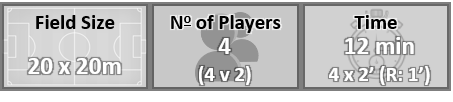
Application game from the exercise 1, solidifying the concept of antagonistic movement: a run perpendicular to the ball’s trajectory, in a 4v2 possession drill. Same field.

A vertical pass from ‘a’ to ‘b’ is paired with a horizontal run by ‘c’ [1, 2a]. Variations include the passer running after the pass [2b], or two players swapping positions with two perpendicular movements [2b + 2c]. If the defense steals the ball, the attackers’ pass count is reset.
Rules
- Attackers score points by completing a set number of passes, but only when each pass is accompanied by a simultaneous antagonistic movement.
- Switch the defenders at every bout.
Variations
Limit the touches on the ball
Suggestions
3. THREE ZONE APPLICATION GAME
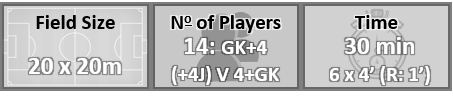
GK+4 (+4 jokers) v 4+GK, played on a 50 x 40m field, split into three horizontal zones: defensive, midfield, and attacking zones. The teams rotate, with one team acting as a ‘joker’ to provide numerical superiority to the attacking team.

Yellows attacking, blues are jokers, reds defending. A vertical pass from ‘a’ to ‘b’ is paired with a horizontal run by ‘c’ [1, 2a]. Variations include the passer running after the pass [2b], or two players swapping positions with two perpendicular movements [2b + 2c]. If the defense steals the ball, the attackers’ pass count is reset.
Rules
- Attackers score points by completing a set number of passes, but only when each pass is accompanied by a simultaneous antagonistic movement.
- Switch the defenders at every bout.
Variations
Limit the touches on the ball
Suggestions
4. PROGRESSION: INTEGRATIVE SITUATIONAL GAME
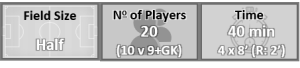
This exercise is played 10 v 9+GK on a half field splitted in three horizontal zones, simulating a 3-2-4-1 vs. 4-2-3-1 formation, Integrating antagonistic movements, switching sites, and attacking the backs of the first offensive line
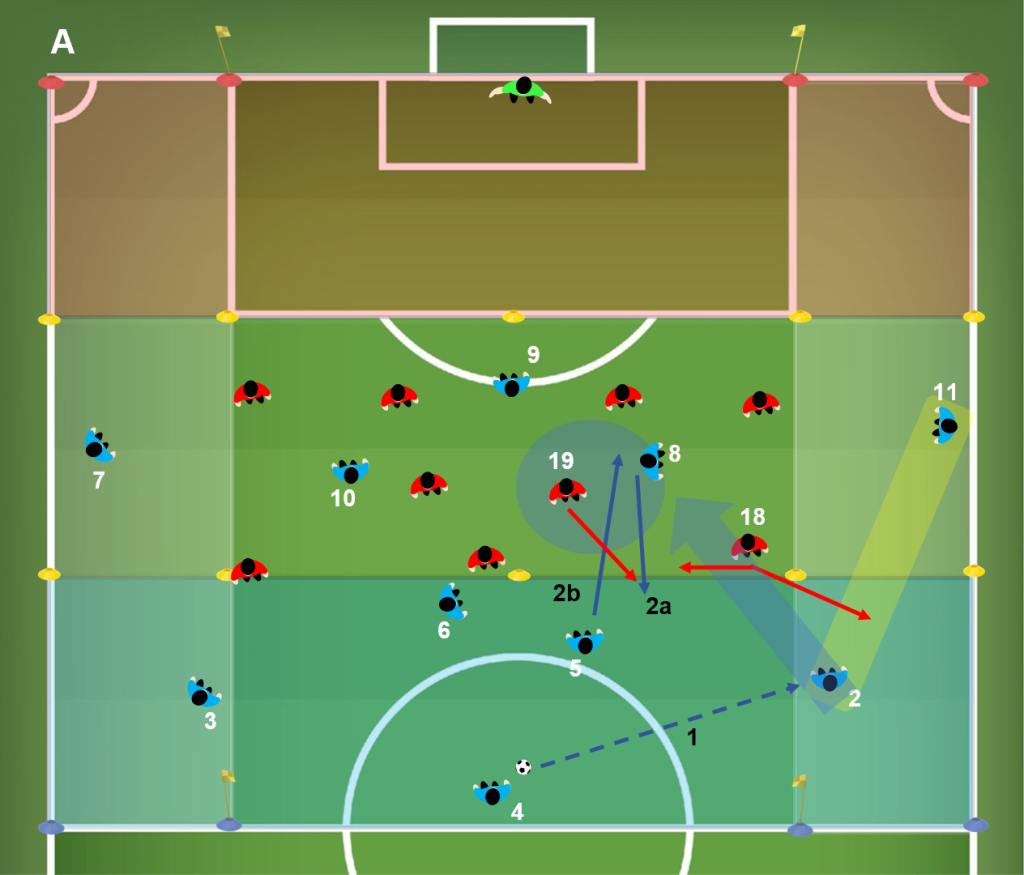
Panel A – the first dilemma: p4 passes to p2 [1], while p8 drops back with a vertical run [2a], attracting p18 and p19. p5 attacks the vacated space [2b], creating a dilemma for p18: pressure p2, close the pass to p5, or cut the lane to p11, guaranteeing a free player (p11, p8, or p5).
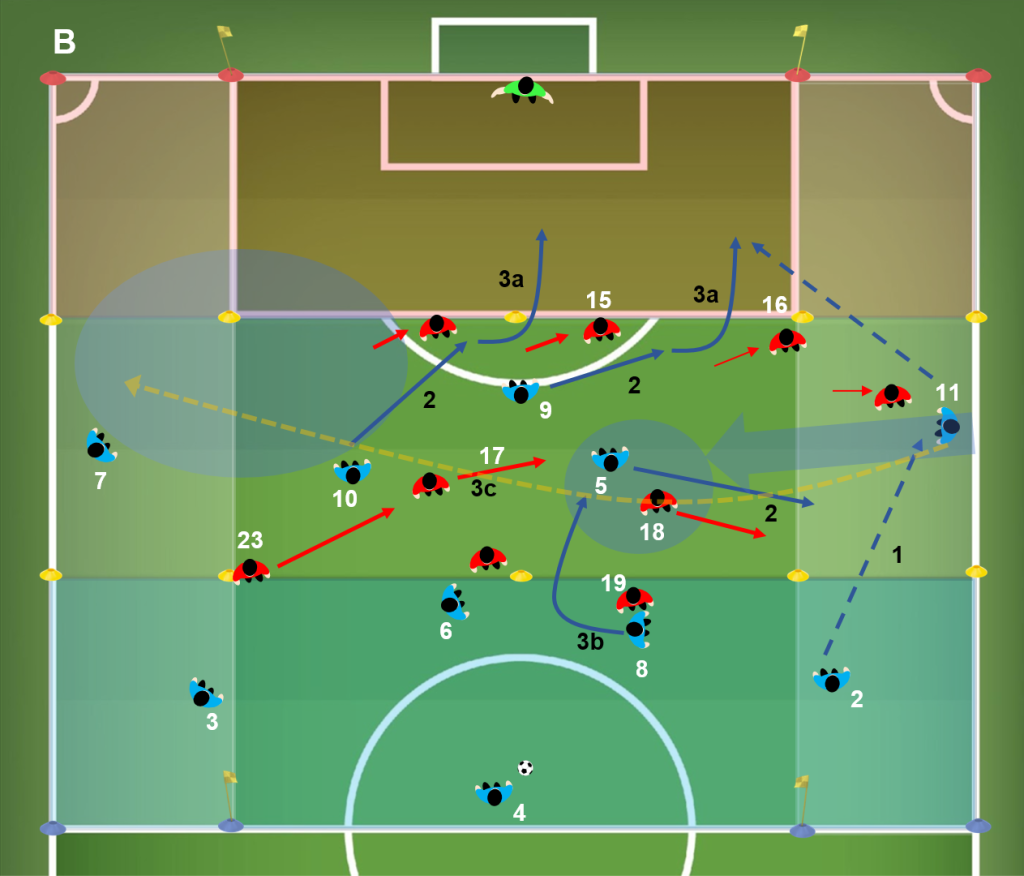
Panel B: assuming that p18 chose to close p5, leaving the wide corridor for p11 open, a new sequence of horizontal runs begins [2]: p5 gets closer to support, while p10 and p9 make runs to the ball side, attracting defenders and opening space. Simultaneously, p8 runs into the vacated space [3b], exploiting a new dilemma: if the first line drops, a large hole opens for a pass from p11 to p8, or space to run with the ball. If p17 chases p8 [2c], it’s probable that p23 covers his space, further isolating P7 for a long ball, or even to attack the far post
Rules
- Ball starts in the midfield. The progression to the next zone or a goal, is only valid if it happens after, at least, 1 antagonistic movement—a run perpendicular to the pass. Each goal counts 3 points.
- Extra points are awarded for using the side corridors (one extra point per time that a corridor is used). Not only with a long ball, but also direct passes on the ground.
- The defense has a maximum of 5 seconds to win back possession and cross the midfield line.
Suggestions

About the author:
Jeferson Matos is a soccer (football) coach with A license held by Conmebol (Argentina), UEFA C (Portugal), Bachelor in Physical Education and Sports (Federal University of Minas Gerais, Brazil), having coached, assisted and been tactical analyst in Brazil, Saudi Arabia, Oman and the United States of America.